

Every five years, I decide I am going to try to love pants again. Here’s the thing: pants may have easy construction but they’re the hardest to get the fit right. I can not tell you how many times I’ve made pants that ended up in a donation pile. I understand the saying, “pants are a journey,” very clearly now.

I won’t go into all of my fit issues, well… because we all have them. I am not special. What I am going to give you are the valuable tips I’ve learned along the way. My hope is that you have success on your pants journey.

Beginners
Start with loose-fitting pants, knit pants, or wrap pants. These are so much more forgiving when it comes to fit.


Make a Muslin and then turn it into a Block/Sloper
Many problems are solved with a muslin (a mock-up). After you get the fit right, trace it out on paper or poster board to make a sloper/block (a master pattern your size). Ease, crotch ease, waist height, all circumferences, including waist, hip, thigh, calf, and ankle, would be checked when making a muslin. This will save you so much time and waste. When making your muslin, you do not need to do any closures or finishing like hemlines, finished edges, or such. 2026, goals here.
For stretch you will want to use a similar fabric with the same amount of stretch for the correct fit. If you do not want to do either of these and instead go by the pattern’s recommended sizing I recommend using a pair of pants you love and compare those measurements.

Vintage Sizing vs Modern Sizing.
A big challenge is sizing. Modern big box patterns add ease, a ton of it! Ease is the wiggle room in our clothing. Swimwear and knits have negative ease, meaning they are smaller than your measurements. Ease is also a personal preference. An example, I am a solid 12 in vintage big box pattern pants. The recommended measurement guide is the same for the new patterns. The problem is that the new patterns have a lot of ease built in. New patterns will usually give the finished hip measurement on the tissue. If you are lucky, it will give you the waist, too. If not, you will need to measure the waistband. And don’t forget to be subtracting the seam allowances.


Fluctuating Weight
We all deal with this. I can make a pair of woven pants and fit them at night around the time of my cycle or around a holiday. They might be a little snug, sure. But then I put them on the next morning and they fit perfectly. Below is a great example. See the smile in the crotch? It was just that day, please remember this and be kind to yourself.

I like to make my waistlines a little larger and add hidden elastic to the waist instead of a waistband. No matter my size that day, these britches in stitches will fit.

Fit Issues
In the sewing world, anything that doesn’t fit your body is called a fit issue. It is not an issue with your body. They cannot make everything fit every perfect body out of the envelope. Our bodies are all different. When you make pants and you see drag lines (diagonal folds, creases, wrinkles in the garment), bagging out (too big), pulling (lines of tension meaning something is too tight), you can do a quick online search with a description of your problem, or better yet, have a great reference book, a couple are listed below.

The lines and bagging out indicate they’re too big. This was the size the modern pattern said to use. New patterns have a lot of ease. This is a fit issue.
Last, although certainly not least, is Ruth Collins Top Down Center Out Method. She is a wizard at solo fitting and making just half of a muslin once while still achieving the fit.
A couple reference books to have on hand will save you time, too.

Remember, no one really knows what they are doing when they get started and we all start at the beginning.
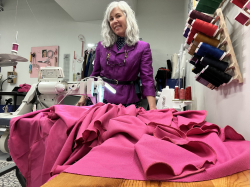
Behind the Scenes ~ come see me and my free demos for Rosewood Art Center’s Holiday in Kettering, Ohio

Thank you for reading,
Tracy McElfresh
Dream it! Sew it!
- How To Be Prolific In Your Craft - October 19, 2026
- Three Big Things Underlining Fabric Can Do - October 16, 2026
- Original Prints Available $15 - October 14, 2026


Leave A Comment
You must be logged in to post a comment.