Happy 2026. Can you believe it is already 2026? As I sit here eating chili in my studio, it is 19 degrees in Dayton, Ohio. Staying motivated with goals feels hard in this cold, and staying on track feels even harder. Still, I am happy to be back to work doing alterations and making time for what I truly love, dressmaking.
Lately, I have been reflecting on all that I do and know, where I am going, what I am sharing, and how best to use my time. “It all boils down to joy,” says my friend Joy2Sew. She is right. Everything is not always planned, and with that mindset, I ran with my second dress of the year.
I have been using flat pattern blocks and drafting my own patterns a lot lately, but when I realized I only had one and a half yards of fabric, I reached for a TNT pattern. TNT means tried and true. Flat pattern blocks are basic blocks made from your specific measurements. From there, you can draft almost any design. As long as your weight stays the same, the fit should not require alterations. That said, for a first draft of any design, I always recommend making a muslin to test proportions and walk through the construction process.
Some of my basic blocks. After three years, I am over 100.
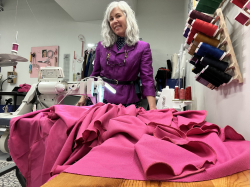
I have made this 1970s Hawaiian Pattern Pacifica 3007B twice now. The first version was in a sequin knit. This one is made from vintage brocade for Valentine’s Day.
This pattern has great pictures and directions, cute flowers printed on it, and it is printed in pink. I love that. It refers to this style of Hawaiian dress as a Muu. I had never seen a bust dart placed in the armscye before.
My only alteration was cutting a size larger and leaving the sides open. I then sewed the armscyes using the burrito roll method so I could try it on and pin the sides to determine how much to take in.
The burrito method is typically used for clean finish armholes on lined sleeveless garments, but it can be adapted for many other situations. These include yokes, pillowcases, enclosed sleeves, and I have even used it for swimsuit linings. It works by rolling the bodice main and lining together into a tube, sandwiching the sleeve and armscye area to create a very clean, fully enclosed seam.
Because people ask. Total sewing time for this dress, including cutting, setting up machines/serger, sewing, and pressing, was five hours. That’s extra fast because I’ve made this before!
Behind the scenes, I am still teaching at Rosewood Art Center and hosting fabric swaps and sew-ins with The Dayton Garment Designer Meet Up. Our next meet-up is March 20th, 2026, at Wright Memorial Library in Oakwood, Ohio. 5:30-8:30 Pm.
Tracy McElfresh is an alterations and fit specialist, Kettering Arts Council member, and Kettering resident. Tracy has a skillset built from multigenerational roots in the sewing and garment industries. Operating out of a studio located inside Rosewood Art Centre she provides alterations, garment design (including a strong passion for swimwear), formal and casual dressmaking, and sewing classes. Tracy founded a meetup group in 2014 called the Dayton Garment Designers Meet Up that is open to all newcomers at any skill level. In her free time, she is an avid writer and blogger and was a recognized award winner in 2018 as having one of the Best Dressmaker Blogs on the Planet from Blogspot. You can follow her work on Facebook and Instagram at TracySews.




Leave A Comment
You must be logged in to post a comment.